
11/6/2025
Proven by time and climate: 10 years of testing FATRAFOL 810 membrane
In an environment where temperatures commonly fall far below freezing, winds reach speeds of up to 150 km/h, and solar radiation is affected by the ozone hole, one of the world’s most unique tests of plastic materials is taking place.
After ten years of exposure in two very different environments – at the J. G. Mendel Scientific Station in Antarctica and in the urban environment of Brno – we carefully analysed samples of the FATRAFOL 810 roofing waterproofing membrane in our laboratory. The aim was to assess the technical condition of the membranes exposed to completely different climatic conditions and, based on the results, estimate their remaining service life.
The testing focused on key parameters documenting possible changes in properties. It included assessment of changes in chemical composition, surface microscopy, thickness measurement, colour inspection, plasticiser content and other tests.
From the range of tests carried out, two results were selected as examples. The first is surface microscopy of the compared samples at 480× magnification. The images show that the surface of the sample from Antarctica (left) is almost free of contamination, with virtually no visible particles or dirt. Only a change in the surface structure caused by weathering can be observed. In contrast, the sample from Brno (right) shows a larger amount of dust and other particles, as well as the initial growth of microorganisms, such as algae and lichens, in the form of thin thread-like structures.
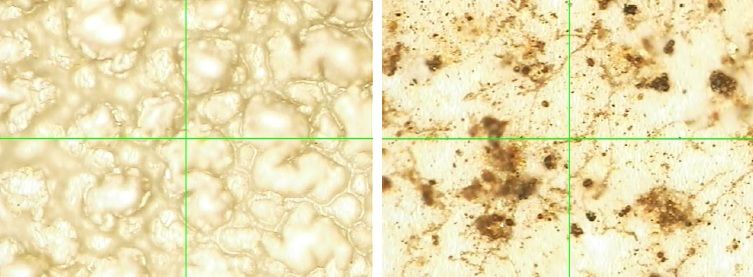
Figures 1 and 2: Comparison of the surface of both exposed membrane samples – left: sample from Antarctica, right: sample from Brno
The second example from the testing is microscopy of the sample cross-sections, taken with a digital microscope at 170× magnification. The surface of the sample from Antarctica shows slight surface disruption, mainly related to weathering in this extreme environment. However, the degradation is minor and affects only a very thin layer on the surface of the membrane’s top layer. It should also be noted that the dark oval shapes in the images are not holes, as they may appear, but polyester reinforcement fibres cut across their cross-section.
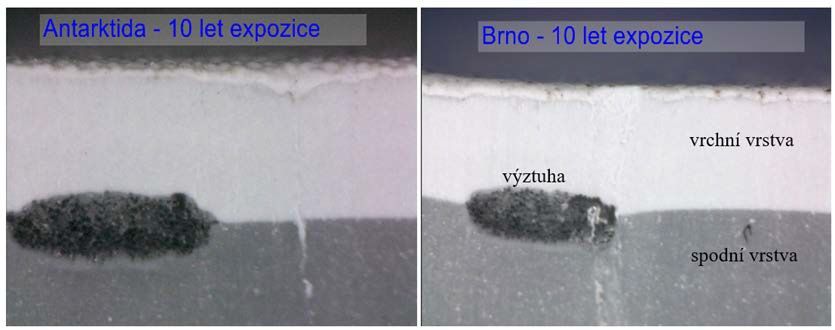
Figures 3 and 4: Microscopy of the FATRAFOL 810 membrane cross-section after 10 years of exposure – left: sample from Antarctica, right: sample from Brno
Both images demonstrate that the membranes are in very good condition. Neither sample showed any significant surface damage, and the observable change in the surface layers is only minimal in depth.
When assessing which external factors had the most negative effect on the materials during exposure, in local conditions these were mainly the frequency of rainfall and higher temperatures. In Antarctica, the key factors were primarily UV radiation and ozone. Overall, it was concluded that neither of the tested materials showed any major changes in properties that would affect the waterproofing function of the membranes. Based on the results, we can assume that the membranes will retain their functional performance for many more years.
In view of these excellent results, it was decided that the next sampling would take place only after a total of 20 years of exposure, i.e. in 2035.
For construction companies, architects and end users, this sends a clear message: if you are looking for a material that can withstand conditions where others fail, FATRAFOL 810 is a choice backed by ten years of evidence. Directly from the harshest continent on Earth.